Metabolic & Fitness Testing
Stop estimating. Measure how your body actually uses energy and oxygen.
Metabolism + VO₂ testing uses portable breath analysis to measure how your body uses energy at rest and how efficiently your heart, lungs, and muscles use oxygen during exercise.
Instead of relying on generic formulas, wearable estimates, or “calories burned” guesses, you get objective information about your resting metabolism, fuel use, cardiorespiratory fitness, and training zones.
Testing is available through scheduled locations, pop-ups, and partner events.
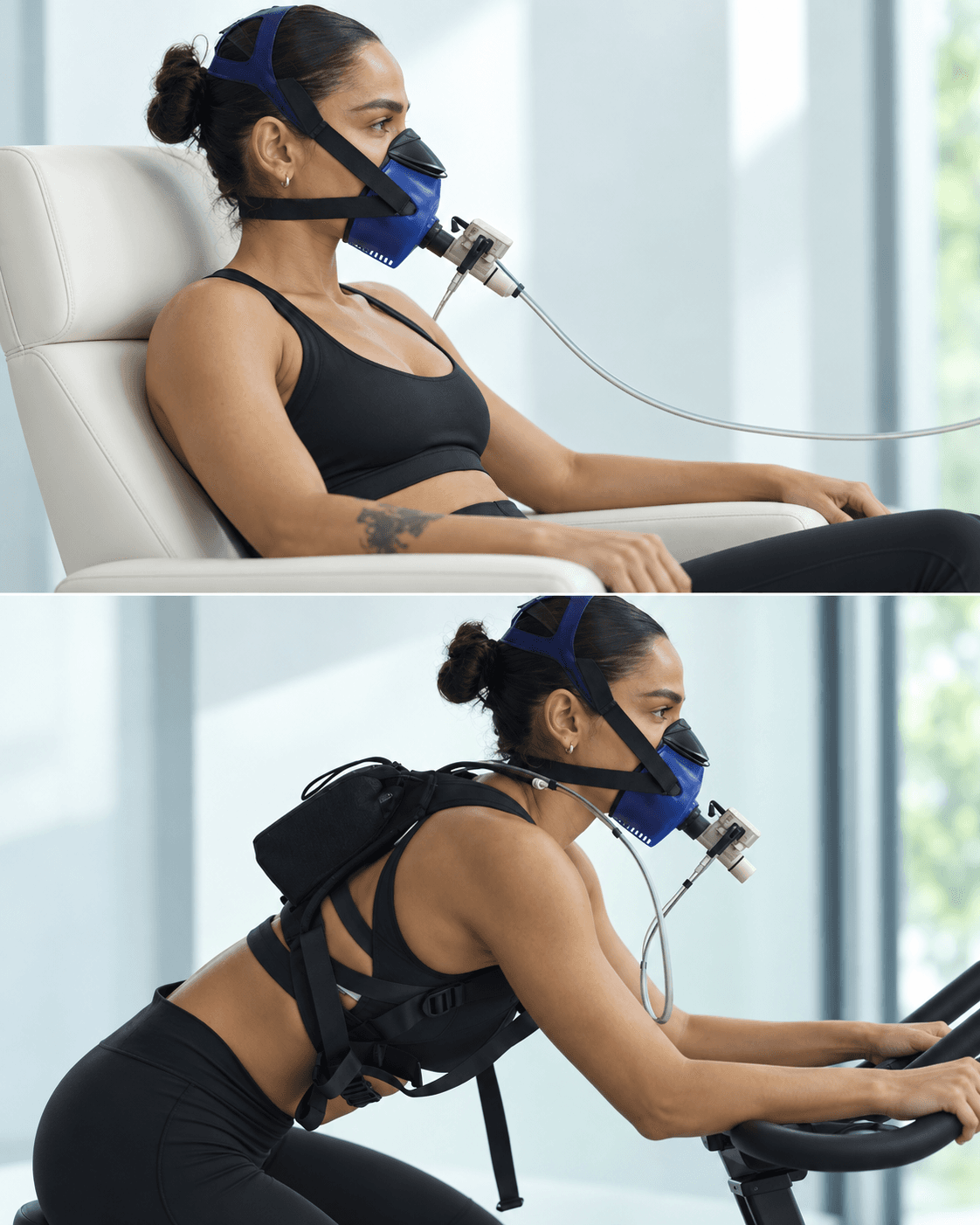
What is metabolic breath testing?
Metabolic breath testing measures the oxygen you take in and the carbon dioxide you breathe out.
Those measurements help estimate how your body is producing and using energy, either while you are resting quietly or while you are exercising at increasing intensity.
Resting metabolic testing can help show:
- How much energy your body uses at rest
- Whether your measured metabolism is higher or lower than predicted
- Whether you are relying more on fat or carbohydrate for fuel at rest
- How your basic energy needs compare with your current nutrition goals
VO₂ testing can help show:
- How much oxygen your body can use during hard exercise
- Your cardiorespiratory fitness level
- Individualized heart-rate and training zones
- How your body uses fuel at different exercise intensities
- A baseline you can retest after a training, nutrition, or health phase
The Science
The mask measures the oxygen you breathe in and the carbon dioxide you breathe out. From that, the system can estimate how your body is producing and using energy. At rest, that can help show your resting metabolic rate and fuel use. During exercise, it can help show your cardiorespiratory fitness, training zones, and how your body responds as intensity increases. In plain English: instead of relying on formulas or wearable estimates, you get data based on your actual breathing.
Choose your test
Resting Metabolic Rate
Choose RMR testing if you want to understand how much energy your body uses at rest and how that compares with an estimated metabolism. This is a good starting point if you are working on nutrition, body composition, under-fueling, weight-management, metabolic health, or a baseline before making changes.
VO₂ Max Testing
Choose VO₂ testing if you want to understand your cardiorespiratory fitness, aerobic capacity, training zones, and how your body uses oxygen during exercise. This is a good fit if you are training for performance, rebuilding fitness, tracking healthy aging, or want more precise information than a wearable or age-based formula can provide.
Midlife Metabolism & Hormone Audit
Choose the Midlife Metabolism & Hormone Audit if you want resting metabolic testing placed inside a broader conversation about menopause symptoms, hormones, labs, nutrition, strength, recovery, and next steps.
Resting Metabolic Rate (RMR): $125
Your resting metabolic rate is the amount of energy your body uses at rest before exercise, errands, work, stress, or the general chaos of being a person gets added on top.
Online calculators estimate this number from population averages. Breath testing measures it from your actual oxygen consumption and carbon dioxide production while you rest.
RMR testing is for you if:
- Dieting has been unsuccessful or felt unsustainable
- You want to start, are currently taking, are coming off, or want to come off a GLP-1 medication
- You want to know if you're fueling appropriately for building and preserving muscle
- You want to support your active lifestyle with nutrition targets built around your measured energy needs rather than a generic formula
- Your weight, body composition, energy needs, or response to dieting seems to have changed
- You want a measured baseline before changing your nutrition, training, body composition, or health strategy
- Everything is going well and you simply want to know your actual resting metabolic rate as a baseline
You’ll receive your complete PNOĒ results along with a personalized, plain-English summary from Jessie highlighting the numbers worth paying attention to and what they mean. Results & summary available within 72 hours after testing.
Want to understand what those numbers mean in the bigger picture of your hormones, symptoms, nutrition, strength, recovery, and midlife health? The Midlife Metabolism & Hormone Audit adds that deeper assessment and strategy.
VO₂ Max Testing: $195
Your fitness is a vital sign.
Blood pressure, cholesterol, and heart scans show how the structure of your heart and arteries is holding up. VO₂ max measures what they can’t: how well your heart delivers oxygen to the rest of your body, and how well your body is able to turn it into energy. It’s one of the strongest predictors of how long and how well you’ll live, and the American Heart Association calls it a clinical vital sign that should be monitored regularly.
During the test, exercise intensity increases gradually while the mask measures your breathing and gas exchange.
What you’ll walk away with:
- Where you stand on one of the strongest predictors of long-term health
- Heart-rate zones built from your body, not an age formula, so your workouts do what you want them to
- A clearer picture of why your effort isn't paying off, and what to change
- How far above the “independence line” you are, and how to stay there
- A baseline you can retest and watch improve
Your full report also includes your measured VO₂ max, ventilatory thresholds, and how you use fat and carbohydrate at each intensity.
This test is for you if:
- Recovery is taking longer than it used to, and you want to understand what may be limiting you
- You exercise consistently, but the results don't seem to match the effort
- You keep losing and regaining the same weight or more
- You're focused on building and preserving muscle while also protecting cardiovascular health
- You're returning to exercise after a break and want to make progress with less trial and error
- You have insulin resistance, prediabetes, fatty liver, or another metabolic issue and want more information about how your body responds to exercise
- You're intentional about how well you're aging and want objective cardiorespiratory fitness data as part of the bigger picture
- You want to make the heart-rate and exercise data from your wearable more useful
- You're already highly fit and want to see where your current ceiling is, identify where you can improve, or earn some legitimate bragging rights
You do not need to be a runner or an endurance athlete. Testing can be performed on a bike, rower, or inclined treadmill, with the protocol matched to your current fitness level.
You’ll receive your complete PNOĒ results along with a personalized, plain-English summary from Jessie highlighting the numbers worth paying attention to and what they mean. Results & summary available within 72 hours after testing.
This is a fitness and wellness assessment, not a diagnostic cardiac stress test. People with known or suspected heart or lung disease, unexplained chest pain, fainting, or significant exercise symptoms should be evaluated medically before participating.
Why VO₂ max matters
Low fitness carries more risk than smoking
In a study of more than 750,000 adults, low fitness was linked to a higher risk of death than smoking, type 2 diabetes, or high blood pressure.
Same scan, different odds
Two people can have the same heart scan and the same risk factors. The one with low fitness is two to three times more likely to die early.
Lean isn't the same as fit
In a study of nearly 400,000 people, fit people at a higher body weight had no significantly higher risk of death than fit people at a “normal” weight. People with low fitness had about twice the risk, whatever they weighed.
The independence line
VO₂ max declines with age, and there's a point where it starts to limit your independence. Sedentary adults lose roughly 10% per decade after about 30. Active people still decline, but they start higher and stay higher at every age. For women, the level tied to living independently at 85 is about 15 mL/kg/min, and about 18 for men. Below that, climbing stairs or carrying groceries gets hard. Staying well above that line is what training is for.
Low fitness: a bigger risk than smoking or diabetes
Risk of death from any cause in 750,302 adults ages 30 to 95, followed for a median of 10 years
Bar chart of relative risk of death from any cause. Least fit, compared with most fit: 4.09 times the risk. Low fit, compared with most fit: 2.88 times the risk. Smoking: 1.40 times the risk. Type 2 diabetes: 1.34 times the risk. Cardiovascular disease: 1.28 times the risk. High blood pressure: 1.15 times the risk. A value of 1x means no added risk.
Source: Kokkinos et al., Journal of the American College of Cardiology, 2022. Fitness bars compare the least-fit (bottom 20%) and low-fit groups with the most-fit group. Risk-factor bars compare people with and without each condition.
Sources: Kokkinos et al., 2022, Franklin et al., 2023, Weeldreyer et al., 2024, Paterson et al., 1999, Hawkins and Wiswell, 2003. VO₂ testing is a fitness and wellness assessment and does not diagnose disease.
Want both?
Bundle your RMR + VO₂ Max testing for $275 and save $45.
The tests can be scheduled separately so each can be performed under the conditions that give you the most useful results.
What to expect
Before testing, you’ll complete a short health and readiness screening so we can confirm the right test and identify any safety concerns.
During the appointment, you’ll wear a fitted mask connected to the portable analyzer. The mask allows the system to measure your breathing and gas exchange while you rest or exercise.
For RMR testing
You’ll rest quietly while the system measures your breathing. The breath measurement itself takes about 10 minutes, but plan about 30 minutes for the full appointment, including setup, time to settle into a true resting state, testing, and equipment reset.
For VO₂ testing
You’ll exercise on a bike, rower, or inclined treadmill while the intensity gradually increases based on your current fitness level. After a short warm-up, the active portion generally lasts about 8 to 12 minutes, followed by a cool-down and recovery. Plan about 30 minutes for the full appointment. You decide when you’ve reached your maximum effort, and the test can be stopped at any time.
Basic preparation
RMR preparation
- Morning testing is preferred whenever possible
- Finish your last meal or caloric drink preferably 10 to 12 hours before testing and at least 7 hours beforehand. A normal overnight fast is ideal
- Drink water normally and arrive comfortably hydrated
- Avoid caffeine, pre-workout, stimulants, nicotine, food, and caloric supplements before testing
- Avoid alcohol the evening before testing
- Avoid hard, long, or unusually strenuous exercise during the 24 hours before testing
- Continue normal prescribed medications unless your physician has instructed you otherwise
VO₂ Max preparation
- Arrive fueled and normally hydrated rather than intentionally fasted
- Eat normally earlier in the day and finish your last meal or caloric beverage at least 4 hours before testing
- If caffeine is part of your normal routine, your normal low amount earlier in the day is fine. Avoid additional caffeine or stimulants for approximately 2 to 3 hours before testing
- Use your normal routine rather than introducing a new pre-workout or stimulant on testing day
- Avoid hard, long, or unusually strenuous exercise during the 24 hours before testing
- Continue normal prescribed medications unless your physician has instructed you otherwise
- Wear comfortable exercise clothing and the shoes you normally use for training
You’ll receive a link to these preparation instructions in your booking confirmation and appointment reminders.
Want to book a test?
Check the current testing schedule to see where Jessie is testing next and which appointments are available.
Want to host testing?
If you own or manage a gym, studio, clinic, office, retreat, or wellness space, you can request a testing day for your members, clients, employees, or guests.
Which test should I choose?
Choose RMR if you want to understand:
- Your measured energy needs
- Nutrition and fueling needs
- Weight or body-composition changes
- Under-fueling or prolonged restriction
- Muscle-building and muscle-preservation needs
- Metabolic changes before, during, or after GLP-1 use
- Your resting fuel use
- Your metabolic baseline before making changes
Choose VO₂ Max if you want to understand:
- Cardiorespiratory fitness
- Individualized training zones and thresholds
- Recovery and exercise response
- How your fuel use changes as intensity increases
- Whether your training is producing the adaptations you expect
- Fitness and healthy-aging trends
- How to make your wearable data more useful
- Your current performance ceiling
Choose the Midlife Metabolism & Hormone Audit if:
You want your RMR results placed inside a broader assessment of your hormones, symptoms, nutrition, strength, recovery, lifestyle, and the factors influencing how your body is functioning in midlife.
Add VO₂ Max testing to your Audit for $150.
Better data makes better decisions easier.
Whether you want to understand your resting metabolism, measure your cardiorespiratory fitness, dial in your training zones, or get a clearer baseline before your next health or fitness phase, metabolism and VO₂ testing can help you stop guessing.
Book a standalone test, find an upcoming testing location, or bring testing to your gym, studio, clinic, office, retreat, or event.